
Sulfur As A Plant Nutrient
Sulfur is important for balancing soils as a soil amendment, and also as a plant nutrient. Sulfur is taken up by plants primarily as sulfate (SO₄). Sulfate is important in photosynthesis and plant metabolism, which produces proteins, enzymes and amino acids. Sulfur can also help to improve plant stress tolerance, disease resistance and nutrient efficiency.
Modifying Soil With Sulfur
ADJUSTING pH
Sulfur is used to lower the pH of alkaline soils. Neutral pH is considered optimum for plant health. Some nutrients are more soluble (available) at lower pH, such as boron, copper, iron, manganese and zinc. Other nutrients are more soluble at higher pH, such as molybdenum, phosphorous, and potassium. Neutral pH is the level at which the key macro- and micronutrients are optimally soluble.
Specialized naturally-occurring soil bacteria, Thiobacillus and Bacillus, thrive on sulfur, oxidizing it into sulfate (SO4) which produces a mild form of sulfuric acid. The sulfuric acid (H2SO4) then disassociates, leaving hydrogen ions (H+) in the soil that reduce pH, and sulfates (SO4) that are taken up by plants as a nutrient, or attach to another positive ion. These newly formed sulfates are very soluble in the soil, either bonding with nutrients and facilitating uptake by plants, or combining with salts and enabling them to leach below the root zone.
REDUCING BICARBONATES
Bicarbonates (HCO3) enter the soil profile, carried by groundwater irrigation. Bicarbonates are large molecules, and can monopolize the cation exchange sites on the soil particle, blocking desired nutrients from attachment. The sulfuric acid produced by the bacterial breakdown of sulfur breaks the bonds of the bicarbonate molecule, converting it into carbon dioxide gas (CO2), which leaves the soil.

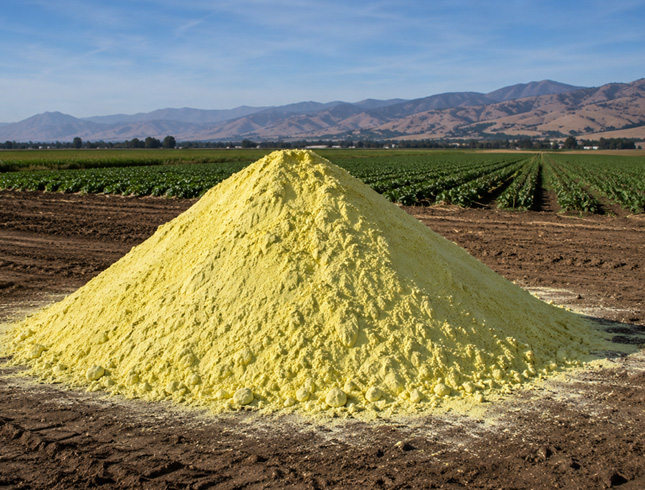
Sulfur
Sulfur can also help to improve plant stress tolerance, disease resistance and nutrient efficiency.